

No need to always use taxis and Ubers.
Fortunately, Morelia is a very walkable city. (According to walkscore.com, Morelia scores 99 out of 100 for walkability. For comparison, New York City has a score of 82, and Dallas clocks in at 46.) This means you will be able to move quite easily through the city without owning a car.
However, if you're not keen on a lot of walking (perhaps you have a bag of groceries or maybe it looks like rain is imminent), you needn't worry. Morelia's public transportation network gives you a lot of options.
As you walk through the city, you'll see lots of different buses and vans, and it can all seem a little intimidating. But fortunately, it can be easier than you imagine, even with a limited amount of Spanish.
Let's see what options we have:
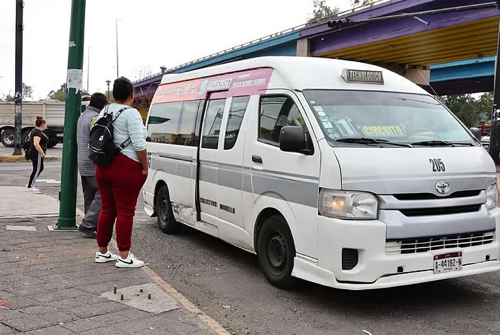
Combi
The name combi is an old term that originated in the 1950s as Volkswagen developed the Kombi van, first produced in Germany, and then in Brazil, and then VW began making them in Mexico. This vehicle was designed for family transport (and later with a pop-top specifically for camping), but its affordability and reliability made it a natural for public transportation uses.
The combis we see today (you may also hear them referred to as colectivos—because they "collect" people along the route) are most usually not made by VW, but rather Toyota. They seat approximately 12–13 people with room for more standing.
The routes in Morelia (and many parts of Mexico) are distinguished by a color and a number. For example, you will find four different routes of the Roja combi: Roja 1, Roja 2, Roja 3, and Roja 4. Each of the colored routes have generally the same routing (especially as they move through Morelia's historic center), but as they leave Centro they veer off to cover slightly different neighborhoods.
Here's a specific example: the Roja 1 runs east and west, and is a great option for those looking to go from Centro to Las Americas. But note there are really two "flavors" of the Roja 1: one route that goes out Madero and then turns south to Las Americas, while the other continues on Madero and climbs the hill at the very eastern edge of the city. So how do you know the difference and get on the right one? Fortunately, you have a few options.
Read the windshield and side windows
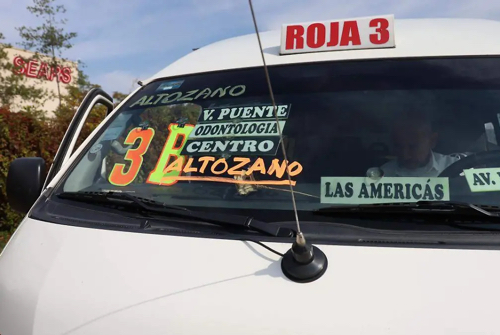
The windshield contains a lot of information to help you. You will see major locations, neighborhoods, streets, and landmarks listed to give you an idea of the routing. (The challenge for folks new to the city is that these locations often don't mean anything!) For example, in this example, you can read Las Americas, V. Puente (Calzada Ventura Puente), Odontología (the University of Michoacán School of Dentistry), Centro (this we know!), and Altozano. Yes, the Roja 3 combis now continue to the mall at Altozano—in the past the only option was to take one of the camiones (see below.)
So the windshield (or sometimes this information is also printed on the side window) will give you a good idea of where this combi is going. In the case of the Roja 1, you will see a designation of Punhuato (the hill on the east end of town) or Com Mex (the general name for the Las Americas shopping area.) Still not sure?
Ask the driver or fellow passengers
Many native Morelianos who don't regularly take public transit or who are going to a new destination are often just as confused as you are. So they simply ask fellow passengers, or even better, the driver himself. (Yes, almost all of the combi drivers are men...although there are a few women now starting to acquire routes.)
Fortunately, you don't need a lot of Spanish to do this. Simply ask "a Las Americas?" The driver will either say yes, or give you an explanation of which combi you need. If you don't understand the explanation, ask the driver of the next one. Everyone knows it can be a little confusing, so please don't worry...there will always be someone who will help you.
Consult an app
If you like to have a plan of attack before you leave the house, or just want more certainty, there are a couple of apps and resources that can help you. Knowing in advance the route you are looking for will give you much more confidence. In many cities, public transit routes and schedules are incorporated into Google Maps, but unfortunately not in Morelia. So you'll need to use a third-party tool.
Uitsi Transporte Morelia
Uitsi is a free app available for Apple or Android devices that provides a clean interface for looking at route maps. Along the top of the Routes section are options for most of the route colors, and by clicking one you can see the route map and all of the "variants" of that route.
The "Cerca de mí" option shows you what routes are near your current position, helpful if you're out and about and need to get somewhere. The "Busqueda" view lets you input your current location and where you want to go in order to see which routes you might be able to use. You can also mark favorite destinations for regular trips.
The only problem with this app is that it does not list the camión routes (other than one), so there may be a transit option that you won't know about using Uitsi.
Moovit
Moovit (free and available for Apple or Android devices) has a much more cluttered interface, but it also includes all of the camión routes, so it perhaps gives you a better picture of the options available. It also purports to tell you how long the wait is for the next bus, but this may or not actually work.
However, the free version forces you to view 5-second ads every few clicks, so it may be frustrating to use unless you upgrade. (Also, there are errors in some of the routings, so perhaps don't trust this app 100%.)
El Rutero
El Rutero is not a standalone app, but rather a website (that you could save to your device's home screen, making it function like an app.) El Rutero works especially well on larger computer or tablet screens, allowing you to drag "Origin" and "Destination" pins on the map, and then showing all of the routes (with possible connections, if needed) to travel between the two. Also available is an option to enter the origin and destination addresses.
On the top right, you can click the "Rutas" button to view all of the available routes (camiones included): click a route to see its map. This site also includes public transport route maps for 19 additional cities in Mexico, so it can be a useful tool if you travel throughout the country.
It is ad supported, but there is a paid option to remove the ads.
Get on board
Riding the combi is a chance to participate fully in regular daily Mexican life. You will ride with students heading to class, professional people going to work, older women going to an appointment or coming back from the mercado, etc. You will be (sometimes very closely) seated together and so good manners are important.
It is traditional and courteous to greet the passengers as you board—a simple buenos días or buenas tardes (as appropriate) is sufficient. As more passengers board, return the greeting from the new passengers.
Either hand your money to the driver as you board ($12 pesos) or take a seat and then pass your fare to the person next to you, asking "Te lo paso?" Your money will make its way up to the driver, and your change will come back the same way.
While it is helpful to have the exact fare, it is not required; the driver can make change. If pressed, drivers will try to make change for a $500 peso bill, but there may be some eye-rolling. Better to use as small a bill as possible.
If the combi is getting crowded, try to push together to create as much free space as possible. If the combi has become standing room only and you see a passenger holding a bag or package, it is a nice gesture to offer to hold it for them. (You can accomplish this with just a gesture—this is a universally understood act of kindness.)
The front passenger seat is also an available seating choice for the combi. You won't have the same communal experience as sitting in the back, but the front seat offers a more comfortable seat and more room. There is no need to engage in a conversation with the driver—he has enough to do, stopping and starting, making change, staying vigilant, etc. But if you have a question, feel free to ask it. Drivers are generally very helpful.
Getting off
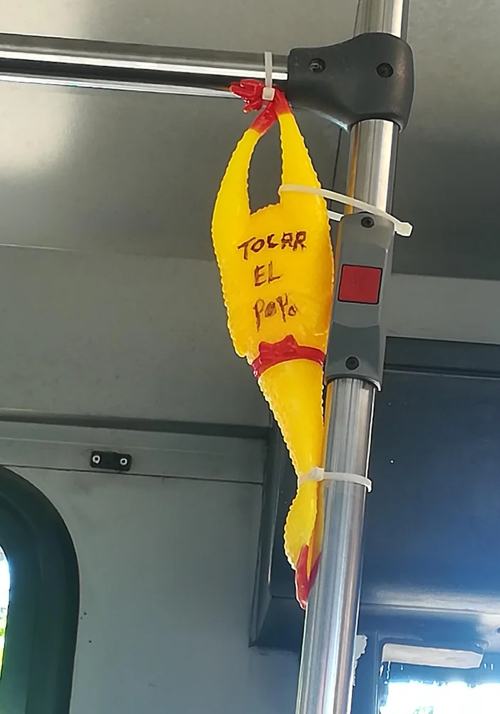
When you want to get off, press the button to signal your stop. Buttons are placed along the inside ceiling and are usually easily reached. If you press the button and there is no sound, call out "la esquina, por favor" to be dropped at the next corner.
It is probably expensive and time-consuming to have to repair the wiring, so Mexicans become very resourceful in dealing with this problem, and come up with another way to signal your stop. If you see a rubber chicken hanging there, it means the signal is broken and you should squeeze the chicken to make it squawk.
When you depart, it is also courteous to say "gracias" to the driver as you step out. You will also hear many people offering blessings to the passengers as they step out.
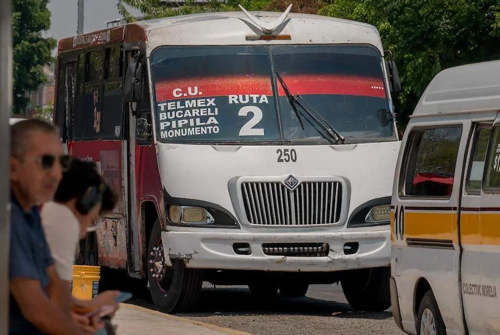
Camión
The Camión is the larger, clouds-of-exhaust-spewing vehicles that tend to serve longer routes and larger streets. Many times they are more direct than the winding combi routes, and they offer traditional bus-style seats (albeit often hard plastic ones.)
Riding the camión is very similar to the combi; give the driver your fare upon boarding and then take a seat. Passengers on the camión generally don't proffer the same greeting upon boarding, but it's a nice gesture to at least greet the driver. (On some routes, you will receive a small paper receipt—keep this while onboard, because occasionally there are checks of tickets, mostly to make sure the driver is properly collecting the fare.) Like the combi, the fare is $11 pesos, and the driver can make change.
To help with the flow of passengers, it's best practice to enter the camión via the front door and exit via the rear. (In fact, the buzzer is located next to the back door.) If you have a couple of bags of groceries, the camiones often offer slightly more space than do the combis.
It is not unusual for a vendor to board the camión and walk through, selling snacks, doughnuts, or other products. Purchase if you like, but there is no obligation. There are also musicians who might board to offer a song—feel free to provide a tip if you enjoyed the performance!
Helpful routes
There are some routes that may be particularly helpful as you navigate the city; one or more of these may become your standard conveyance:
Amarilla 1
This combi runs a loop (in both directions) around Centro—running along Cuatla in the west, along 20 de Noviembre and Eduardo Ruiz in the north, Plan de Ayala and Ventura Puente in the east, and Iretaticateme and Solidaridad to the south.
This combi also stops at the corner of the CU (Ciudad Universitaria) campus of the University of Michoacán, and sometimes the combi stops and you need to board a new one to continue your journey. But this only affects the journey if you're in that southwestern corner of the route.
Azul A
This combi runs along the streets just north of Madero and goes past Walmart and La Comer until its termination at Las Americas.
Cafe 1
This combi (but not Cafe 1-A) runs alongs the streets just south of Madero, going down Ventura Puente and on to Las Americas and La Comer.
Cafe-Oro 2
This combi has a very similar route to the Cafe 1, but it runs part of its route towards Las American along Boulevard García León.
Centros Comerciales
This camión, as its name implies, connects commercial centers. It runs from the Morelia bus terminal, along Avenida Pedregal, along Manuel Muñiz/Lázaro Cárdenas near Mercado Santo Nino (Nicolas Bravo) and directly in front of Mercado de Independencia, down Ventura Puente past the Convention Center/Orquidario park to the Fiesta Camelinas shopping center, and along the Periférico past Las Americas, La Comer, and Walmart.
Industrial-Hospitales
This camión runs along the streets just north of Madero and continues east on Madero, serving the main IMSS Hospital Charo and Hospital Manuel Silva.
Jesús del Monte
This camión originates/terminates at Plaza Carrillo, moves south down Calzada Benito Juárez, and goes up the hill to Vista Bella and continues on to Paseo Altozano.
Naraja 1
This combi runs north and south through the heart of Centro, stopping at Costco.
Naranja 2
This combi runs from Centro down Avenida La Huerta to the plazas containing Walmart, Home Depot, and Chedraui.
Naranja 3-Santa María
This combi runs through Centro and heads south to climb the hill into Santa María de Guido, running past the dental office of Dr. Juan Cruz and continuing to the center of Santa María.
Oro-Verde
This combi has a similar route to the Naranja 3, traveling past the dental office of Dr. Juan, but in Centro it traverses the streets around the bosque.
Roja 1-Com Mex
This combi connects the main Morelia bus terminal with Las Americas and La Comer, running along Madero in the Centro.
Roja 3
This combi (but not 3-A or 3-B) runs along Madero and goes down Ventura Puente to Las Americas and then travels through the tunnel to Paseo Altozano, dropping you off right at the mall's front door.
Verde 1, Verde 2
These combis runs along Mañuel Muñiz/Lázaro Cárdenas until they connect to Aqueducto (at the main OOAPAS office), and then turn south towards Sam's Club, Walmart Express, and Las Americas.